
 EN
EN
How to Choose the Right Cookware Set Material for Better Cooking Results?
Have you ever stood in front of a wall of cookware sets, completely unsure which one actually suits how you cook? You are not alone. The sheer variety of materials, coatings, and constructions makes choosing a cookware set feel more complicated than it needs to be. The truth is, the material your cookware is made from has a direct and measurable impact on your daily cooking performance — and once you understand what each material does well, the decision becomes much clearer.
As a cookware industry specialist who has spent years evaluating how material and design translate into real cooking outcomes, I find that most buyers skip the material question entirely and jump straight to price or appearance. That shortcut often leads to frustration later. This guide walks through the most common cookware materials, what each one actually delivers in the kitchen, and how to match your choice to the way you genuinely cook.
Why Cookware Material Matters More Than You Think
The material your cookware set is made from determines three fundamental things: how quickly it heats up, how evenly it distributes that heat across the surface, and how long it holds up under regular use. These three factors shape almost every cooking outcome, from whether your eggs brown evenly to whether your stew develops the depth of flavor you expect.
Cookware that heats unevenly creates hot spots — those frustrating zones in the center of a pan where food burns while the edges stay undercooked. Cookware that loses its non-stick properties after a few months forces you to use more oil or accept food that sticks. Choosing the right cookware material from the start prevents these problems before they start.
Aluminum Cookware: The Foundation of Most Sets
Aluminum cookware forms the base of the majority of non-stick cookware sets sold globally, and for good reason. Aluminum has a thermal conductivity of approximately 205 W/(m·K) for pure aluminum — well above most metals used in home cooking. What this means in practice is that aluminum heats quickly and spreads that heat broadly across the cooking surface, reducing the risk of uneven browning.
One of the most reliable signals you can check when evaluating a cookware set is base thickness at the edge — the difference between entry-level and mid-range aluminum options is usually visible without any tools. Thicker-gauge aluminum bases produce more consistent cooking results because they hold heat more steadily as you add food. Thinner bases can spike and drop in temperature, leading to inconsistent outcomes especially when cooking proteins.
If you mostly cook at medium heat and use silicone or wood utensils, a standard aluminum non-stick cookware set should perform well for everyday meals — but if you regularly cook at high heat for searing, you will want a material better suited to that task.
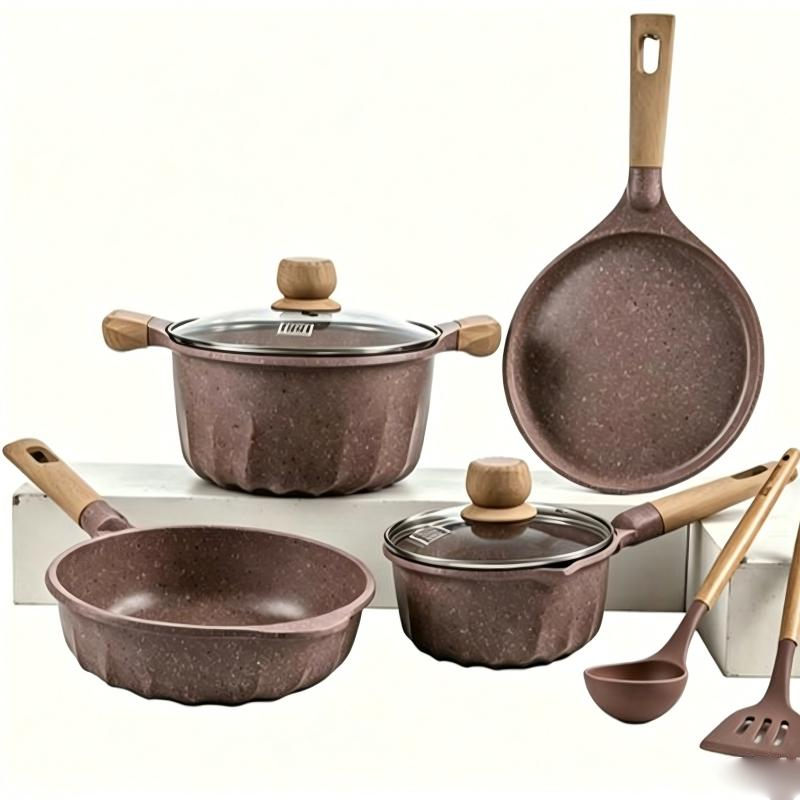
Non-Stick Coated Aluminum: Convenience With Trade-offs
Most aluminum cookware sets come with a non-stick interior coating. This pairing of a fast-heating aluminum base with a non-stick surface for easy release is the most widely sold configuration in mid-range kitchen equipment. The coating reduces the need for excess cooking oil and makes cleaning straightforward for daily use.
With non-stick coated aluminum cookware, coating quality is the variable that matters most. PFOA-free labeling is now a standard baseline across most cookware sets — it does not, by itself, tell you whether the coating is a single light layer or a multi-layer system. Coating application consistency and layer count determine how long the non-stick cooking performance lasts under regular use. Sets in the mid-range price bracket typically offer better coating durability than entry-level alternatives, but the most reliable way to evaluate this is to check base construction alongside coating claims.
It took me a while to understand that the right cookware set for your kitchen depends entirely on how you cook — there is no universal answer. Someone who makes French-style omelets four times a week has different needs from someone who primarily braises meat or stir-fries at high heat.
Stainless Steel: Durability and Long-Term Value
Stainless steel cookware sets occupy a distinct position in the kitchen equipment landscape. While stainless steel has lower thermal conductivity than aluminum — roughly 15 to 17 W/(m·K) — this is compensated in quality sets by adding an aluminum core layer sandwiched inside the steel walls, combining the durability of stainless with the heat distribution of aluminum.
Stainless steel does not have a non-stick coating, which means it requires more technique — proper preheating, the right amount of fat, and patience before moving food. In return, stainless steel handles high-heat searing, browning, and deglazing better than non-stick coated aluminum. For home cooks who prioritize flavor development through the Maillard reaction — the browning that creates depth in sauces and seared proteins — stainless steel delivers results that coated surfaces cannot match.
Stainless steel cookware sets are also generally more resistant to surface damage from metal utensils, which extends their practical lifespan significantly. Stainless steel makes particular sense as a long-term investment for households that cook frequently and want kitchen equipment that does not need replacing every few years.
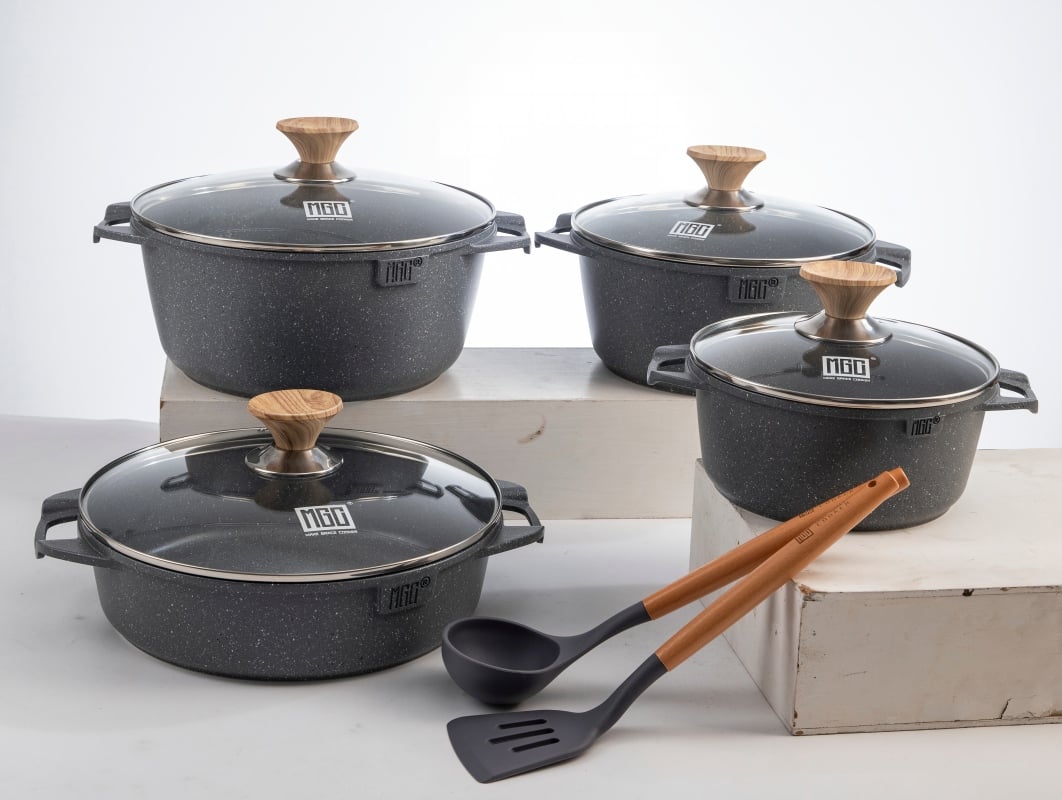
Ceramic-Coated Cookware: The Newer Alternative
Ceramic-coated cookware sets have grown in market presence as buyers have sought non-stick options that are PFAS-free rather than simply PFOA-free. Many buyers treat ceramic and traditional PTFE-based non-stick coatings as interchangeable — but they have different heat tolerance thresholds and wear patterns. Ceramic coatings generally perform well at lower to medium cooking temperatures and offer a smooth initial release. However, ceramic coatings can be more sensitive to thermal shock and may show wear faster under high-heat conditions compared to quality PTFE multi-layer systems.
For buyers in this category, the aluminum base construction matters just as much as the coating choice. A ceramic-coated pan with a thin aluminum base will still heat unevenly regardless of how premium the coating is.
Matching Cookware Material to Your Cooking Style
When buying a full cookware set on a fixed budget, it usually makes sense to allocate more toward quality core pieces — a frying pan and a saucepan — and save on items like large stockpots that are used less frequently. A well-constructed aluminum non-stick frying pan handles most everyday cooking tasks, while a stainless steel saucepan or casserole handles acidic sauces and long-simmered dishes where coating longevity could otherwise become an issue.
Here are some practical considerations to guide your choice:
- If your priority is everyday convenience with easy cleanup, a mid-range aluminum non-stick cookware set with a multi-layer coating is the most practical choice for most households.
- If you cook at high heat regularly, sear proteins, or cook acidic dishes frequently, a stainless steel or stainless-with-aluminum-core set offers better durability and cooking performance for those tasks.
- If reducing chemical exposure in non-stick coatings is a priority, ceramic-coated aluminum sets are worth considering — with attention to base construction quality.
- For households that cook diverse cuisines across different heat levels, a mixed-material cookware set — aluminum non-stick pieces alongside a stainless steel stockpot or casserole — often provides better overall coverage than a single-material set.
What to Look For Beyond the Material Label
The material type is only one part of evaluating a cookware set. Base thickness, handle construction, and coating consistency are equally important variables. You can usually tell a lot about a pan's base quality just by tapping the bottom — a hollow, thin sound versus a solid, dense sound tells a different story even before you cook with it. Heavier weight at the same price point often signals a meaningful difference in base construction compared to lighter options in the same category.
A cookware set that performs well across your actual cooking routine — the meals you cook most often, the heat levels you use most frequently, and the amount of care you are realistically willing to give — will serve you far better than the technically superior set that does not fit how your kitchen actually works.